

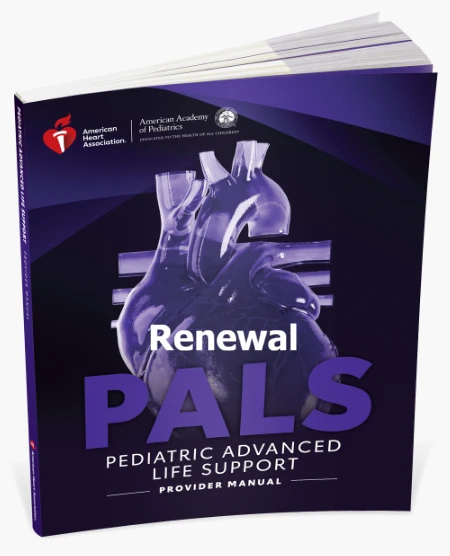
AHA PALS Renewal / Update / Refresher Courses (INCLUDES Provider Manual E-Books and FREE BLS!) at First In Last Out Medical Response 3322 Coors Blvd NW Suite 4 Albuquerque, NM 87120
American Heart Association AHA
$275.00
(No reviews yet)

Write a Review

American Heart Association AHA
AHA PALS Renewal / Update / Refresher Courses (INCLUDES Provider Manual E-Books and FREE BLS!) at First In Last Out Medical Response 3322 Coors Blvd NW Suite 4 Albuquerque, NM 87120
AHA PALS - Pediatric Advanced Life Support at First In Last Out Medical Response 3322 Coors Blvd NW Suite 4 Albuquerque, NM 87120.
An American Heart Association PALS Renewal (Pediatric Advanced Life Support Renewal) is a refresher/update course for clinicians who already hold a current PALS Provider certification and need to re-validate their knowledge and skills before their card expires (or shortly thereafter).
Be sure to download the confirmation letter, study guide, agenda, ebook and more after your purchase!
Here’s what a PALS Renewal class typically involves:
Purpose & Audience
-
Intended for healthcare professionals (physicians, nurses, paramedics, etc.) who already have a PALS Provider card and wish to renew before expiration.
-
Focuses on refreshing, reinforcing, and evaluating the skills and decision-making needed for pediatric emergencies, rather than teaching everything anew.
-
The AHA recommends PALS providers renew at least every 2 years. medicalcenter.virginia.edu+2cpr.heart.org+2
Course Format & Duration
-
The Renewal course is usually offered instructor-led / classroom format. cpr.heart.org+1
-
Our renewal course includes a summary, lectures, evaluation stations, a written exam, and optional practice time. medicalcenter.virginia.edu
Requirements / Prerequisites
-
To enroll, you typically must hold a current PALS Provider card (or within a specified grace period). medicalcenter.virginia.edu+1 showmecpr.com
Content & Skills Evaluated
The renewal class typically reviews and tests the following:
-
Pediatric assessment and systematic approach to pediatric emergencies
-
BLS (infant / child) including high-quality CPR, ventilations, etc.
-
PALS treatment algorithms (respiratory failure, shock, arrhythmias, cardiac arrest)
-
Team dynamics / leadership / coordination in pediatric resuscitation
-
Scenario / “megacode” style simulations to integrate skills and decision-making
-
Written (cognitive) exam / evaluation stations to test knowledge and application
Certification & Validity
-
Successful completion typically results in a new PALS Provider Course Completion Card (or eCard), valid for 2 years. showmecpr.com+2cpr.heart.org+2
-
If participants do not pass the skills / scenario or written components, some programs permit remediation or retesting; others may require retaking a full initial PALS course (especially if out of compliance or expired too long).
-
American Heart Association (AHA) Pediatric Advanced Life Support (PALS) — Complete Overview
Pediatric Advanced Life Support (PALS) is an advanced resuscitation course developed by the American Heart Association (AHA) for healthcare professionals who manage critically ill or injured infants and children. PALS focuses on early recognition, high-quality CPR, team-based resuscitation, and evidence-based treatment algorithms to improve outcomes in pediatric emergencies.
Purpose & Goals
PALS trains providers to:
-
Rapidly recognize and treat pediatric respiratory failure, shock, and cardiac arrest
-
Apply systematic assessment (Primary & Secondary) to pediatric patients
-
Perform high-quality pediatric CPR
-
Use pediatric advanced airway, vascular access, and pharmacology
-
Lead and function effectively within a resuscitation team
-
Follow AHA pediatric algorithms accurately under pressure
Who Should Take PALS
PALS is designed for clinicians who directly care for pediatric patients, including:
-
Paramedics & Advanced EMTs
-
Emergency & ICU Nurses
-
Pediatric & Emergency Physicians
-
Respiratory Therapists
-
Physician Assistants & Nurse Practitioners
-
Hospital-based code team members
-
Flight & critical care transport providers
(PALS is not intended for lay rescuers.)
Prerequisites
-
Current AHA BLS Provider certification (required)
-
Ability to interpret pediatric ECG rhythms
-
Familiarity with pediatric medications and weight-based dosing
-
Strong foundational knowledge of airway management and CPR
Course Structure
PALS courses are offered in several formats depending on the training site:
1. Initial PALS Provider Course
-
Classroom or blended learning
-
Full review of pediatric assessment, algorithms, and skills
-
Written exam + skills testing
2. PALS Renewal Course
-
For providers with a current or recently expired PALS
-
Focused on updates, skills refresh, and testing
3. HeartCode® PALS (Blended Learning)
-
Online cognitive portion via AHA
-
Mandatory in-person hands-on skills session with an AHA Training Center
Core Curriculum Topics
Pediatric Assessment
-
Pediatric Assessment Triangle (PAT)
-
Primary Assessment (ABCDE)
-
Secondary Assessment (SAMPLE, focused history)
-
Recognition of deterioration before arrest
High-Quality Pediatric CPR
-
Age-specific compression depth & rates
-
Infant vs child differences
-
Two-rescuer CPR
-
Minimizing interruptions
-
Ventilation with advanced airway
Airway & Respiratory Management
-
Bag-mask ventilation
-
Oxygen delivery devices
-
Advanced airway placement
-
Respiratory failure vs respiratory arrest
-
Capnography use
Vascular Access
-
Peripheral IV
-
Intraosseous (IO) access
-
Fluid resuscitation
-
Pediatric shock management
Cardiac Rhythms & Electrical Therapy
-
Pediatric bradycardia
-
SVT & tachyarrhythmias
-
Ventricular fibrillation (VF)
-
Pulseless ventricular tachycardia (VT)
-
Synchronized cardioversion
-
Defibrillation (joules/kg)
Pediatric Pharmacology
-
Weight-based dosing (kg only)
-
Epinephrine
-
Amiodarone
-
Adenosine
-
Atropine
-
Magnesium
-
Fluid boluses
-
Glucose management
PALS Algorithms You Must Master
-
Pediatric Cardiac Arrest Algorithm
-
Bradycardia with a Pulse
-
Tachycardia with a Pulse
-
Respiratory Distress & Failure
-
Post-Cardiac Arrest Care
-
Shock Management
-
ROSC (Return of Spontaneous Circulation)
Team Dynamics & Communication
PALS strongly emphasizes Crisis Resource Management (CRM):
-
Clear team roles
-
Closed-loop communication
-
Effective leadership
-
Mutual respect & situational awareness
-
Post-event debriefing
Skills Testing (Hands-On)
Participants are evaluated on:
-
Pediatric CPR (infant & child)
-
Bag-mask ventilation
-
Airway management
-
Rhythm recognition
-
Medication selection & dosing
-
Defibrillation & cardioversion
-
Megacode (team-based scenario)
Written Exam
-
Multiple-choice exam
-
Based on AHA guidelines
-
Passing score required for certification
Certification Details
-
Certification valid for 2 years
-
Issued by the American Heart Association
-
Digital eCard provided after successful completion
-
Accepted nationwide and internationally
Evidence-Based Guidelines
PALS content follows the most current AHA Guidelines for CPR & ECC, which are updated every five years with interim science updates as needed.
Why PALS Matters
Pediatric arrests are rare but high-risk, and outcomes depend heavily on:
-
Early recognition
-
Rapid intervention
-
Accurate dosing
-
Strong team performance
PALS gives providers the confidence, structure, and skills to act decisively when seconds matter.
-
Related Products
-
-
-
AHA BLS For Healthcare Providers Initial Provider Certification at First In Last Out Medical Response 3322 Coors Blvd NW Suite 4 Albuquerque, NM 87120
$50.00American Heart Association AHA
-


